Agami

আমরাই আগামী

Bangladesh doesn't have a jobs shortage. It has a verification problem.

Agami is Bangladesh's Talent Operating System for Gen Z — the place where a Class 9 student becomes a trained, networked, income-earning young professional by the time they finish university, by working on real national-scale projects instead of just taking classes.

Real. Earned. Connected. Free forever. No paid courses, ever. Titles are earned by skill and tasks only.

  • Free forever
  • All 8 divisions
  • Founded 2026
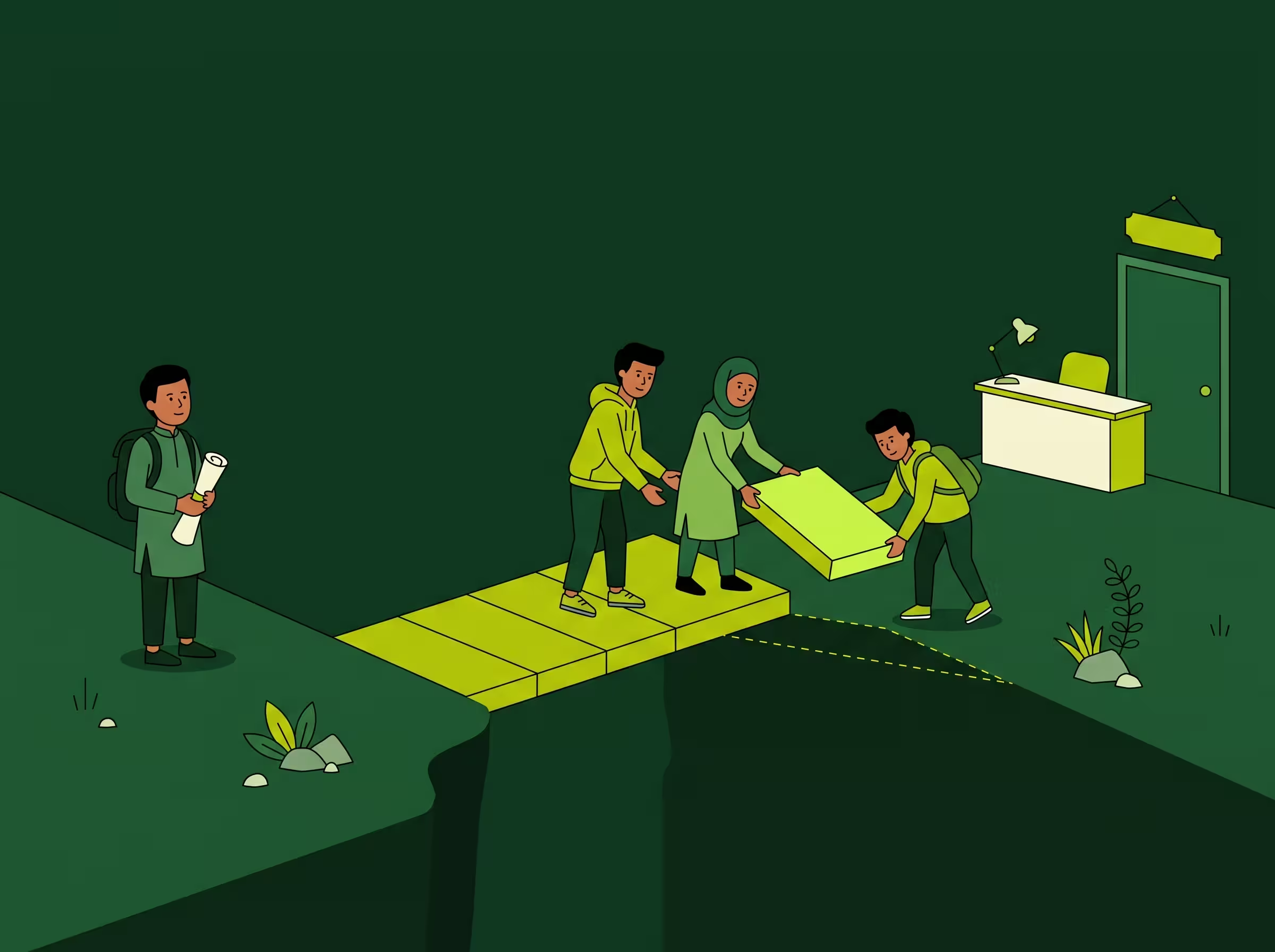
The verification gap, drawn as a half-built bridge
Art brief

ILL-ABOUT-HERO · 1600x1200 · 4/3

Flat vector illustration, clean geometric shapes, minimal outlines. On the left a Bangladeshi university student standing at the edge of a gap in the ground holding a rolled certificate; on the right, across the gap, a simple office desk and door with a small sign shape above it. Spanning the gap, a partly built bridge made of rectangular lime green segments, with three other students actively laying the next segments, and a thin dashed lime line marking the final unbuilt span. Deep forest green background #0D2B1A, lime green #B3CB04 bridge segments and sign, bright lime #C6F04A on the segment being laid, cream #F7F7E1 certificate and desk surface, forest green #19401D ground and structures, warm South Asian skin tones. Simple faces, two-dot eyes. High contrast, no shadows, generous negative space on the LEFT for a headline. No text, no watermark. 4:3.

A generation in school, online all day, increasingly degree-holding — and still unemployed.

Bangladesh produces millions of school and university graduates every year. It does not produce, at any comparable scale, a system that converts that education into verified, job-ready skill and a working professional network. This is the gap Agami is built to close.
Graduate unemployment was 13.5 percent in 2025 — higher than general youth unemployment.
18.9 percent of 15 to 29 year olds are not in education, employment or training.

A degree is not the bottleneck: graduate unemployment runs higher than youth unemployment overall.

Youth unemployment · 2025
9.39%
Tertiary enrolment · 2025
24.32%
Institutions that are private universities
≈60%
Students on social media more than 3 hours a day
over 78%

Source: as compiled by Agami, 2025.

The root cause is not a shortage of work.

Labour market research consistently points to one driver: a structural mismatch between what schools teach (theory) and what employers need (practical, job-ready skill, demonstrated through real work, not just a transcript). This is not a jobs-shortage problem. Bangladesh's economy is creating roles. It is a skills-certification and verification problem — employers cannot tell, from a CV alone, who can actually do the work.

Bangladesh does not have a jobs shortage — it has a verification and conversion problem.

An abstract data field — most of the dots untouched
Art brief

ILL-ABOUT-PROBLEM · 1400x900 · 14/9

Flat vector abstract data illustration, minimal geometric shapes. A wide sparse scatter of small dots, with a single thin continuous line threading through only a small cluster of them and leaving most untouched, and three flat vertical bars of different heights along the lower edge. Cream #F7F7E1 dots, lime green #B3CB04 line and bars, deep forest green #0D2B1A background. Extremely sparse, calm, lots of empty space, no shadows. No text, no numbers, no axis labels, no watermark. 14:9.

Why the four existing options each leave a gap.

Why the four existing options each leave a gap — and where Agami sits.
Existing optionThe gap it leaves
UniversitiesTeach theory at scale but have neither the staffing nor the mandate to run live, paid, real-stakes projects for every student.
Coaching centres and skill-training platformsTeach isolated skills (a design course, a spoken-English course) but do not connect that skill to a real project, a real employer, or real income.
Internship and job platformsAssume a candidate already has a polished CV and a professional digital presence — exactly the layer that is missing for a Class 9 or Class 10 student, or even most university students.
NGOs and youth clubsBuild community and confidence but rarely build a verifiable, performance-based career ladder, and are often perceived by parents as a distraction from academics rather than a CV-builder.

Swipe the table sideways to read both columns.

Agami is designed to sit in the gap between all four — taking the reach of a youth club, the structure of a training platform, the real stakes of a national project, and the outcomes of a placement agency, and fusing them into a single, continuous system.

Not an NGO, not a coaching centre, not a youth club.

NGO suggests charity and low seriousness; coaching centre suggests one narrow skill; youth club suggests a hobby that competes with studies for parental approval.
  • Not a coaching centre
  • Not an NGO
  • Not a youth club
  • Not an event-organising committee that disbands after each programme

So what is it?

Talent Operating System for Gen Z (Class 9 to university graduation) — one continuous system that takes the reach of a youth club, the structure of a training platform, the real stakes of a national project and the outcomes of a placement agency, and fuses them.

Ambitious, performance-driven, nationally-scaled, and credibility-first — never charity-coded, never hobbyist.

One national infrastructure layer.

To become the single national infrastructure layer that converts Bangladesh's youth population — their time, their ambition, and their digital attention — into verified skill, professional networks, and real income, at a scale no university, coaching centre, or NGO can match.

Mission

To build, operate, and continuously expand a nationwide talent pipeline that:

  • Discovers young people (Class 9 through university) wherever they already are — social media, schools, and national flagship events.
  • Digitises and professionalises them — giving every member a professional email, a built LinkedIn presence, and a CV or portfolio starter, regardless of their starting point.
  • Deploys them onto real, national-scale projects with real stakes and, wherever possible, real pay.
  • Trains them on the job and through a structured curriculum, in parallel.
  • Promotes them through an earned, performance-tracked leadership ladder.
  • Connects them, through the Agami Connect marketplace, directly into paid internships, freelance gigs, and full-time roles with partner companies.
  • Retains them as alumni mentors, so the system compounds rather than restarting every year.

Five rules we do not bend.

Every piece of Agami communication, training material, and partner pitch repeats three words.
Performance over privilege
Titles, pay, and promotion are earned through tracked output, never given on the basis of connections, seniority of application, or favouritism.
Transparency as a recruitment tool
Published rate cards, visible promotion criteria, and an open organogram are treated as trust-building assets, not internal HR documents.
Real stakes over simulation
Agami deliberately avoids mock projects and classroom-only training wherever a real deployment opportunity exists.
Compounding network effects
Every member is recruited to also be a recruiter, every project is recruited to also be a training ground, and every alumnus is recruited to also be a mentor.
National scale, not pilot scale
Agami's organisational structure (Central → Divisional → District → Campus) is built from day one to cover all 8 divisions and 64 districts of Bangladesh, not a single city pilot.

  • REALMembers work on real events (such as NBOB), real client deliverables, and real money. Not simulations, not mock projects.
  • EARNEDEvery title — Team Lead, Campus Ambassador, Regional Head — is earned through tracked performance, never simply given or applied for.
  • CONNECTEDEvery member leaves with a referral network, a built LinkedIn presence, and warm introductions into real companies.

One journey, ten stages, every member.

Every Agami member moves through the same ten-stage journey, regardless of which flagship event or track first brought them in. This consistency is what allows Agami to track performance, predict aptitude, and promote fairly at national scale.
The member journey as one continuous lime spine
Art brief

ILL-JOURNEY · 1200x2400 · 1/2

Flat vector timeline, clean geometric shapes, minimal outlines. One continuous slightly hand-drawn vertical lime green line from top to bottom with eleven small circular nodes along it. Beside each node, one tiny simple line vignette: a phone showing a feed, a form, a small chip, three linked figures, a speech bubble with a play triangle, an envelope with a profile card, a clipboard on a small stage, a miniature five-step staircase, a branching tree, two exchanging arrows, a mortarboard being handed to a smaller figure. Deep forest green background #0D2B1A, lime green #B3CB04 line and nodes, cream #F7F7E1 vignette details. Vertical composition, wide empty margin on the RIGHT for text blocks. No text, no numbers, no watermark. 1:2 tall.

  1. Stage 0: Discovery

    Touchpoints: Agami's own Facebook, Instagram and TikTok pages; school and college visits by Campus Ambassadors; word of mouth; and national flagship events such as NBOB, where every event registrant is treated as a warm Agami lead (data shared between the two funnels with consent).

  2. Stage 1: Application

    A detailed application form captures name, institution, class/year, district, self-rated skills, motivation, and a past project or initiative. Every question is designed to predict which department the applicant will thrive in later.

    • Fields: name, institution, class/year, district, self-rated skills, motivation, past project or initiative.
    • Self-rated skill list: writing, design, video editing, public speaking, sales, coding, organising, academics.
  3. Stage 2: Referral Code Issuance

    On submission, each applicant is auto-issued a unique referral code (for example, AGM-DHK-0147) through a lightweight backend — a Google Sheets and Apps Script system is sufficient for Year 1. Every subsequent signup is tracked against the referring code.

    • Example code format: AGM-DHK-0147
  4. Stage 3: The Community Build Task

    Referral is framed as the member's first leadership test: "bring your circle." A shareable Canva template ensures referred members arrive with consistent, on-brand presentation. Who brings four motivated people versus who brings none becomes Agami's first leadership signal on every member.

  5. Stage 4: The Public Proof Post

    Members post a written introduction or short video in the Agami community space, explaining who they are and why they joined. In Year 1, human reviewers — not automated systems — sort every post by signal.

    • Strong on-camera presence → Media/Marketing track
    • Strong writing → Content/Academic track
    • Mentions organising things → Operations track
    • Mentions sales or persuasion → Marketing & Sales track
    • Mentions design tools → Creative/Design track
  6. Stage 5: Professional Digitisation

    Mandatory onboarding, run in batches of 50–100 members.

    • Professional email address — with explicit explanation of why casual handles do not get internship replies.
    • LinkedIn profile build — headline template, photo guidance, About-section template, and immediate guided connection with 20–30 other Agami members.
    • Resume/portfolio starter — a one-pager for school students, a fuller draft CV for university students.
  7. Stage 6: Deployment into a National Project

    Members are deployed into a live national project — starting with NBOB — across five functional tracks.

    • Media & Creative Team — graphics and video, paired with senior designers; strongest work is paid on a piece-rate basis.
    • Operations Team — venue logistics, exam management, and the day-to-day machine behind a multi-event national programme.
    • Academic Content Team — question bank support and fact-checking.
    • Marketing & Sales Team — registration drives, school activation, sponsor outreach support, and social growth — the largest team by default.
    • Partnership Support Team — shadows senior partnership leadership, learning sponsor relations and feeding Agami's future corporate-partnership pipeline.
  8. Stage 7: The Ladder — Earned Titles

    Member → Team Lead → Campus Ambassador → Regional Head → Central Team Intern. Regional Heads and Ambassadors receive real authority and a real CV line — for example, "Regional Head, NBOB 2026, managed 200+ registrations across [district]."

    • Member
    • Team Lead
    • Campus Ambassador
    • Regional Head
    • Central Team Intern
  9. Stage 8: Post-Event Organogram Publication

    After every flagship event, Agami publishes its full organogram — Central → Divisional → District → Campus — formalising the structure permanently as Agami's standing national youth workforce, ready for the next flagship event without a rebuild.

  10. Stage 9: Agami Connect — the Marketplace Layer

    Trained members are routed to partner companies for internship placement, commission-based marketing and sales gigs, and paid design or content freelance work. Full detail in Section 8.

  11. Stage 10: Continuous Engagement & Alumni Status

    Between flagship events, members remain active in structured training tracks (Section 9), preparing for the next of three planned annual flagship events, and climbing toward Alumni Mentor status — at which point they begin training the next incoming batch, looping the flywheel back to Discovery.

Stages are numbered 0 to 10 in the source, giving eleven labelled steps described as a "ten-stage journey".

How it works today

Stages 1 to 4 are already running. This is the exact sequence a new member goes through right now.

  1. Step 1: Fill the form
  2. Step 2: Join the Telegram channel
  3. Step 3: Get your Agami user ID within 24–48 hours
  4. Step 4: Task 01: refer your circle with your ID
  5. Step 5: Task 02: post your intro in the community
  6. Step 6: Attend the masterclasses, earn points

The form opens in Google Forms.

Two parallel curricula, split by life stage.

Agami runs two parallel curricula, segmented by life stage, so that the training a member receives always matches what they are ready to use immediately — either in school life or in early professional life.

School & College Track

Class 9–12
  • English proficiency and spoken Englishweekly speaking circles
  • Debate and public speaking
  • Basic computer literacy and an introduction to codingPython/Scratch level to start
  • Science project and innovation challengesdirectly feeding national flagship events and future subject expansions (Physics, Chemistry, Mathematics)
  • Cultural and extracurricular tracksdrama, art, Model UN-style sessions
  • Digital citizenshipusing social media as a builder and creator, not only as a consumer
School & college panel — a speaking circle
Art brief

ILL-CURRICULUM · 700x900 · 7/9

Flat vector illustration, clean geometric shapes, minimal outlines. Five Bangladeshi school and college students seated in a circle on the floor, one standing mid-sentence with a simple lime speech bubble above them; beside the circle a laptop showing simple coloured code blocks, a small debate lectern, a paintbrush and a simple theatre mask. Modern modest clothing, one hijab. Deep forest green background #0D2B1A, lime green #B3CB04 speech bubble and accents, bright lime #C6F04A on the speaking figure's bubble, cream #F7F7E1 laptop screen and lectern, forest green #19401D floor and furniture, warm South Asian skin tones. Simple faces, two-dot eyes. High contrast, no shadows, generous negative space at the TOP. No text, no watermark. 7:9. Left panel of the ILL-CURRICULUM pair.

University Track

University students
  • Business fundamentalsbasic finance, pitching, and business model thinking
  • Sales & marketing certificationdigital advertising, copywriting, basic Meta/Google Ads literacy
  • IT and digital skillsspreadsheets, no-code tools, introductory programming
  • Graphic design & video editinga Canva → CapCut → Premiere/Photoshop progression
  • Corporate readinessCV writing, interview skills, workplace communication, email etiquette
  • Leadership & team managementtaught experientially through leading a Campus team, reinforced with short formal sessions
University panel — a working desk and a first CV
Art brief

ILL-CURRICULUM · 700x900 · 7/9

Flat vector illustration, clean geometric shapes, minimal outlines. A university student's working desk seen from slightly above: a laptop showing a simple flat advertising-campaign layout, a graphics tablet with a stylus, a single cream CV page, a phone showing a short chat thread, and a small lime certificate ribbon. One Bangladeshi university student working at the desk. Deep forest green background #0D2B1A, lime green #B3CB04 accents and ribbon, bright lime #C6F04A on the certificate seal, cream #F7F7E1 CV page and screens, forest green #19401D desk and clothing, warm South Asian skin tones. Simple faces, two-dot eyes. High contrast, no shadows, generous negative space at the TOP. No text, no watermark. 7:9. Right panel of the ILL-CURRICULUM pair.

Delivery format

Weekly 60–90 minute sessions delivered online (Zoom or Facebook Live), supplemented by occasional in-person regional bootcamps, led by senior Agami team members or invited guests, and recorded and archived for members who cannot attend live.

  • 60–90 min sessions
  • weekly
  • Zoom
  • Facebook Live
  • Recorded and archived

The honest answers, in one screen.

Three groups ask us the same three questions. Here is what each one is worried about, and what is actually true.

Parents

The worry: This is a waste of study time.

What is actually true: It is a structured, CV-building, income-generating activity — not a distraction.

Schools / Institutions

The worry: This pulls students away from academics.

What is actually true: It is presented and run as a CV-builder and skills credential, reinforcing the institution's own outcomes.

Corporate Sponsors / Partners

The worry: This is a donation with no measurable return.

What is actually true: It is a pipeline of pre-vetted, pre-trained, performance-scored junior talent worth paying to access.

Free forever.

Free forever. No paid courses, ever. Titles are earned by skill and tasks only.

For students of Classes 9–12 & University. It costs nothing to join and nothing to stay — Class 9 to university graduation.

A parent and a student looking at a certificate together
Art brief

ILL-PARENTS · 1200x800 · 3/2

Flat vector illustration, clean geometric shapes, minimal outlines. A Bangladeshi parent and their teenage child seated side by side at a home table looking together at a laptop that shows a simple cream certificate shape; a teacher figure standing nearby holding a clipboard. A cup of tea with a small curl of steam on the table. Calm, warm, domestic, unhurried. Deep forest green background #0D2B1A, lime green #B3CB04 only on the certificate border and the steam curl, cream #F7F7E1 laptop screen and certificate, forest green #19401D furniture and clothing, warm South Asian skin tones, the parent in a sari or panjabi. Simple faces, two-dot eyes. High contrast, no shadows, generous negative space on the RIGHT for text. No text, no watermark. 3:2.

Twelve months, one continuous cycle.

Agami's first year is planned as a single continuous twelve-month operating cycle across all of Bangladesh — not a series of disconnected pilots. Each phase below builds directly on the one before it.
  1. Month 1–2

    Foundation

    Brand and legal setup, the member form goes live, and the founding cohort is onboarded through referral chains. Digitisation sessions begin.

  2. Month 2–3

    Deployment into Flagship Project

    Members are assigned into the five functional tracks. On-the-job training starts and the weekly skill sessions begin.

  3. Month 3–5

    Regional + Divisional Events Live

    The heaviest execution stretch of the year — divisional and campus teams run real logistics nationwide.

  4. Month 5–6

    National Finale

    The full organogram is published, top performers move up the ladder, and the first Agami Connect placements run.

  5. Month 6–8

    Consolidation

    The structured curriculum launches in full, and the first Agami Connect partner companies come on board.

  6. Month 8–9

    Flagship Event #2

    A second national event — a scaled property in a new subject, or an Agami Business Case Competition, Innovation Challenge or English-Debate Championship.

  7. Month 9–10

    Agami Connect Scale-Up

    Paid internships and gigs start running at volume through partner companies.

  8. Month 10–11

    Flagship Event #3

    The third annual event, timed around the post-exam season so students are actually free.

  9. Month 12

    Annual Review & Alumni Activation

    The Year 1 impact report is published, top members become Alumni Mentors for the next batch, and Year 2 planning starts.

Scroll sideways for all 9 phases. No phase is anchored to a real calendar month. "Month 1" is never defined in any source. The cycle repeats — Agami is built as standing infrastructure, not a one-year programme.

The part that turns a skill into an income.

Agami Connect is the layer that routes trained members into real work. It is the last stage of the journey, and the reason the earlier stages are tracked at all.
Phase 2 — in build
  • Internship placementsTrained members are routed to partner companies for internships that match the track they were deployed into.
  • Paid gigsMarketing and sales gigs, and paid design or content freelance work, offered to members whose work is already tracked.
  • Full-time rolesWarm introductions into real companies, backed by a verified project line rather than a claim on a CV.

A direct line to 10–20 partner companies For internships and freelance work, through Agami Connect.

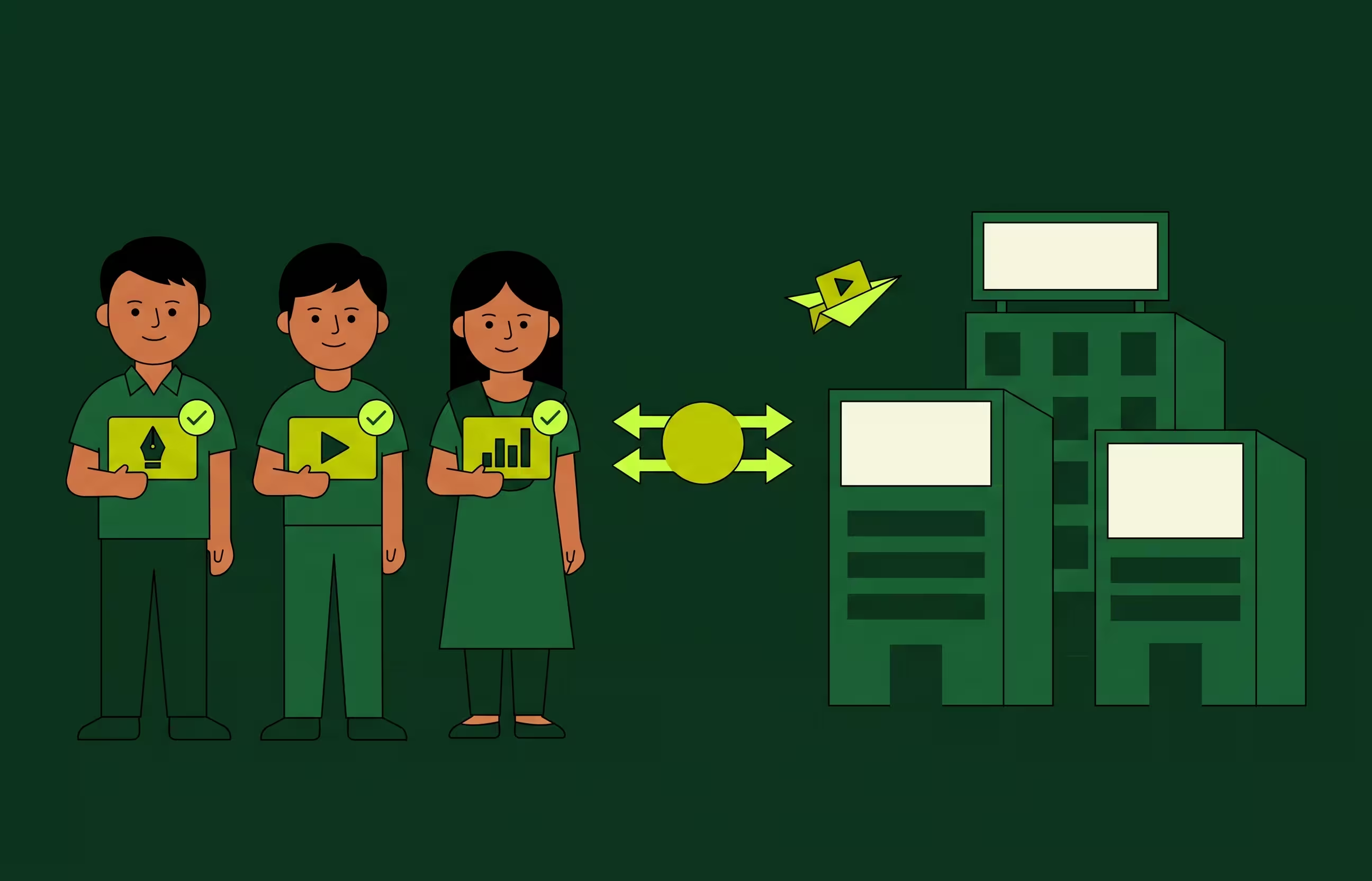
Agami Connect — verified skills routed to real companies
Art brief

ILL-CONNECT · 1400x900 · 14/9

Flat vector illustration, clean geometric shapes, minimal outlines. On the left three Bangladeshi students each holding a small rectangular card bearing one simple symbol: a pen nib, a play triangle, a bar chart, each card with a small check-mark badge. On the right three simple flat office building shapes with completely blank cream signboards. Between them a rounded hub node with paired arrows pointing both ways, and one small paper plane carrying a card across. Deep forest green background #0D2B1A, lime green #B3CB04 cards, hub and arrows, bright lime #C6F04A on the check-mark badges, cream #F7F7E1 signboards, forest green #19401D buildings, warm South Asian skin tones. Simple faces, two-dot eyes. High contrast, no shadows, generous negative space on the RIGHT. No text, no logos, no watermark. 14:9.

Chol, shuru kori.

Bangladesh does not have a shortage of ambitious young people, and it does not have a shortage of jobs that need doing. It has a missing layer of infrastructure that converts one into the other. Agami is built to be that layer — real work, earned titles, and a connected network, at the scale of an entire nation.

Real. Earned. Connected.